
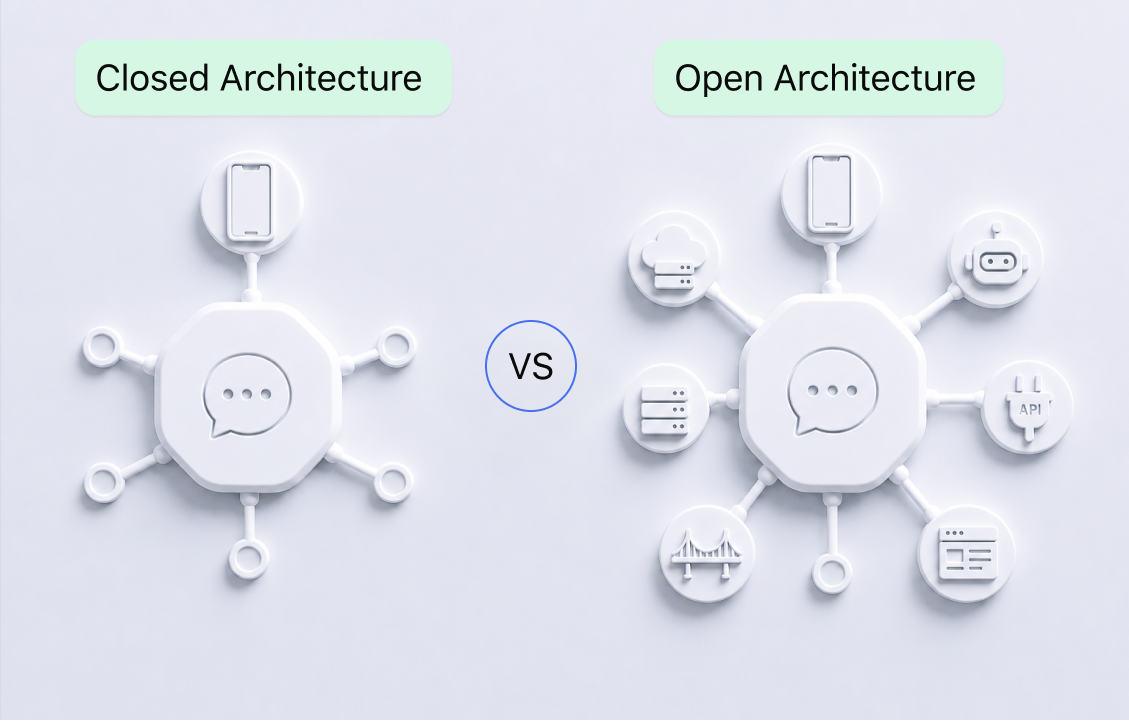
Most messaging apps look simple from the outside. You open a chat, select someone, and send a message. Behind that simple experience, however, messengers can be built in very different ways.
Some operate as controlled environments where communication stays inside one system. Others allow independently operated servers, external bots, outside applications, third-party clients, or even other messaging services to connect.
These connections can provide useful features. They can support automation, custom apps, business tools, and communication between different platforms. But each new connection also creates another path into the communication system, another path that needs to be protected.
In our previous article, we looked at how limited user lookup protects people from unwanted contact. Here, we are looking at a different layer of privacy: the outside systems a messenger allows to connect.
What Is an Open-Architecture Messenger?
In this article, an open-architecture messenger is one that allows external systems to connect to its communication environment.
- Depending on the platform, that may include:
- servers operated by other organizations;
- bots created by outside developers;
- custom or third-party messenger applications;
- bridges connecting different platforms;
- business tools and automated services;
- direct communication with other messengers.
Not every open messenger supports all of these features. Each platform decides which parts of its system to open and what outside developers or services are allowed to do.
A closed-architecture messenger takes a different approach. Core communication stays inside one controlled ecosystem, using approved applications and one set of communication rules. The difference is control.
In an open environment, part of the communication process may depend on software, servers, developers, or companies outside the messenger provider’s direct control. In a closed environment, fewer outside parties are allowed into that process.
Every Extra Connection Is Another Door
Every online messenger needs a controlled connection between its official application and its communication system. Without that connection, users could not sign in, send messages, share files, or make calls.
The security question is how many additional public doors the messenger creates for outside systems. One common door is an Application Programming Interface (API). An API is a set of rules that allows one piece of software to communicate with another.
A messenger may offer an API so an outside developer can create a bot, build a custom application, connect a customer-support system, or automate certain actions.
An API is not automatically a security flaw. But it is another entry point that needs:
- secure access credentials;
- clear permission limits;
- protection against automated abuse;
- monitoring for suspicious activity;
- regular security updates;
- a way to remove access quickly.
Security professionals call all the points where someone can interact with a system its attack surface. The more public connection points a system has, the more places attackers can examine for weak access controls, programming errors, stolen credentials, or incorrect permissions. (NIST Computer Security Resource Center)
The door itself is not the exploit.
The weak lock is the vulnerability. The method used to break or bypass it is the exploit.
That leads to a simple principle: A public door that does not exist cannot have its lock picked.
Every optional connection that is not created removes one more set of credentials, permissions, external software, and security rules that would otherwise need to be trusted and protected.
Federation: When Outside Servers Connect
Federation allows independently operated servers to communicate with one another. Email is a familiar example. A Gmail user can send an email to an Outlook user even though Google and Microsoft operate different systems.
A federated messenger can work in a similar way. One organization operates its own chat server, another organization operates a different server, and the two servers exchange messages through a shared technical system.
This gives organizations more independence. They can operate their own servers while still communicating with a wider network. But it also means that every connected server must process information coming from systems it does not control.
Those outside servers may use outdated software, apply updates slowly, have weaker security settings, or process information differently. A server may also become compromised or be operated by someone deliberately trying to harm other parts of the network.
What Happened on Matrix
Matrix is an open messaging network that allows people and organizations to operate separate chat servers while still communicating with users on other Matrix servers.
In 2025, a serious vulnerability was found in Synapse, server software widely used on Matrix. A malicious connected server could send specially prepared data that stopped a vulnerable server from communicating properly with the rest of the network.
The official security advisory confirmed that the vulnerability had been exploited in real attacks. It also stated that systems without public federation, as well as closed federations containing only trusted servers, were not affected.
The weakness was directly connected to federation. The vulnerable server had to accept and process data coming from another independently controlled server. Without that public server-to-server connection, that particular attack route would not have existed.
APIs and Bots: When Outside Software Participates
APIs allow outside software to perform selected actions inside a messenger. One common use is a bot—an automated account controlled by software. Bots can answer questions, provide customer support, send reminders, process payments, manage groups, or deliver information.
But every bot also introduces an outside operator and, in many cases, an outside server. The messenger must now trust that:
- the bot developer protects their access credentials;
- the bot requests only the permissions it needs;
- the developer’s server is secure;
- the bot does not collect information irresponsibly;
- the automation is not used for spam or fraud.
If a bot’s access token is stolen, an attacker may be able to operate that bot. If the developer’s server is compromised, the attacker may inherit the bot’s legitimate connection to the messenger. Automation can also increase the scale of abuse. A person can send harmful messages one at a time. Software can generate and distribute them continuously.
Third-Party Messenger Applications
Some platforms also allow outside developers to build their own applications that connect to the messenger. The application may connect to the real messaging network, but it is still software created by someone outside the main messenger provider.
That matters because encryption protects a message while it travels. The application still needs to see the readable message on the user’s device before it is encrypted and after it is decrypted. A third-party client may therefore handle:
- account credentials;
- login sessions;
- messages;
- downloaded files;
- contact information;
- local message history;
- encryption keys or other sensitive account data.
Users are no longer trusting only the messenger. They are also trusting the outside developer who created the application.
Even if the main communication system remains protected, a badly designed or malicious client can expose information directly on the device. For a messenger focused on private communication, controlling which software is allowed to connect is therefore just as important as protecting the connection itself.
Interoperability: When Different Messengers Connect
Interoperability allows users of separate messaging services to communicate directly. For example, a person using one messenger may be able to send a message to someone using another messenger without either person changing apps.
From the user’s point of view, it may look like one normal conversation. Technically, however, two different systems are now involved. The services must coordinate:
- user identities;
- message delivery;
- encryption;
- files and media;
- group membership;
- blocking;
- spam reporting;
- disappearing messages;
- differences between privacy settings.
Each messenger may have its own applications, servers, security processes, update schedule, and rules for handling user data. That means one provider no longer controls the complete communication path.
Why Zangi Keeps Private Communication Closed
At Zangi, we made a deliberate architectural choice. We do not design our core private messenger as a public platform for external bots, third-party messaging clients, federated servers, or outside messaging networks. Zangi users communicate inside one controlled environment through the official Zangi applications. We control the communication rules, the supported software, and the way information moves through the system.
That removes several outside dependencies from private communication. With no public bot platform, there is no public bot access token that can be stolen and used to operate inside private chats.
With no open third-party client platform, users do not have to trust an outside developer to handle their readable messages, account sessions, or local communication data. With no public federation, Zangi does not have to accept communication instructions or specially created server data from unknown server operators. With no cross-messenger interoperability, another messaging company does not become part of a Zangi user’s private conversation.
This controlled architecture works together with Zangi’s wider privacy model. Communication is protected with end-to-end encryption, users communicate through private Zangi numbers, and communication history remains on the user’s device rather than becoming a permanent server-based chat history. (Zangi) Some messaging platforms are designed to become broad ecosystems for developers, bots, custom applications, and connections with other networks.
Zangi is designed for a different purpose: Private communication inside a controlled community. That is not a missing feature. It is the architecture working exactly as intended.
Every optional public door we leave out is one less door that needs a lock, one less key that can be stolen, and one less outside party that users must trust.